
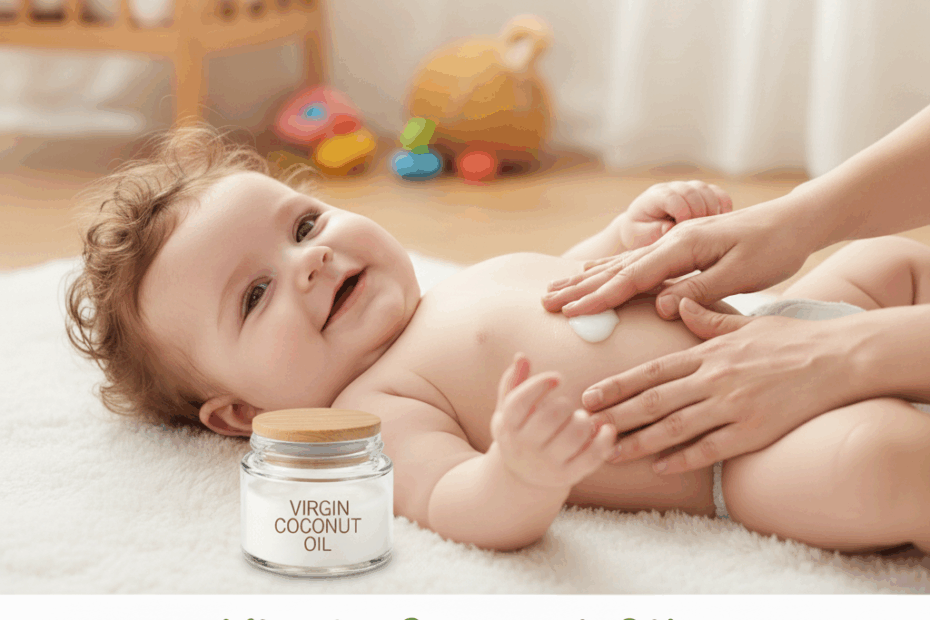
Key takeaways:
- Demonstrated short-term moisturizing benefit
Clinical observations show that virgin coconut oil can improve skin hydration and reduce transepidermal water loss when used sparingly on intact infant skin over short periods. - Simple, single-ingredient profile
For caregivers trying to avoid fragrances, preservatives, and complex formulations, high-quality VCO offers a minimal ingredient option with fewer variables to trigger irritation. - Natural antimicrobial properties
Its high lauric acid content provides measurable antibacterial activity in controlled settings, which may support skin hygiene in mild, non-inflamed conditions. - Accessible and widely available
When properly sourced and processed, VCO is easy to obtain, affordable, and familiar to many caregivers, reducing reliance on poorly understood cosmetic blends. - Useful in limited, targeted applications
In specific cases such as mild dryness or temporary softening of cradle cap scales, cautious use of VCO can be effective without introducing pharmaceutical actives.
This article synthesizes available dermatological observations and nutritional research related to the topical use of virgin coconut oil (VCO) for babies. The author is a technical writer, not a pediatrician or dermatologist. The information provided is for educational purposes only and does not substitute for clinical diagnosis or professional medical advice. The objective is to evaluate the documented properties of VCO and its observed effects on infant skin without promotional bias.
Problem Framing
Parents increasingly seek natural alternatives to synthetic emollients for managing infant skin concerns such as dryness or cradle cap. A common assumption is that natural substances are inherently inert or universally compatible with sensitive skin. This assumption is flawed.
Infant skin differs structurally and functionally from adult skin. It has a thinner stratum corneum, higher permeability, and a developing acid mantle. Many general skincare recommendations fail because they overlook how certain oils can disrupt lipid organization, alter surface pH, or contribute to occlusion-related irritation when used indiscriminately.
Context and Applicability
The observations discussed here apply primarily to full-term infants with intact, healthy skin. These considerations do not apply to:
- Preterm infants with highly permeable skin barriers
- Infants with diagnosed atopic dermatitis, eczema, or broken skin
- Infants with known or suspected nut or seed allergies
In warm or high-humidity environments, the utility of heavy occlusive oils may decrease, as excessive occlusion can contribute to heat-related rashes such as miliaria.
Evidence and Observations
Several small clinical studies have examined the topical use of virgin coconut oil in pediatric populations. Trials published in peer-reviewed journals have reported improvements in skin hydration and surface lipid levels following regular application over short durations, typically around 28 days.
In these studies, approximately 5 ml to 10 ml of VCO was applied twice daily. Observed outcomes included reduced transepidermal water loss (TEWL) and increased skin capacitance, both indicators of improved moisture retention.
Unlike refined coconut oil, virgin coconut oil retains phenolic compounds and antioxidants due to minimal heat and chemical processing. While these compounds demonstrate beneficial properties in laboratory settings, their interaction with the developing infant skin microbiome is not fully understood and remains an area of ongoing research. Long-term safety data is limited.
Comparative Lipid Profiles
Virgin Coconut Oil vs Synthetic Emollients
Many synthetic emollients rely on petrolatum or mineral oil to form an inert, occlusive barrier that reduces water loss without interacting biologically with the skin. Virgin coconut oil differs in composition and behavior.
Lauric Acid Content
VCO consists of approximately 48 percent to 52 percent lauric acid. In laboratory settings, lauric acid and its derivative monolaurin have demonstrated antimicrobial activity against organisms such as Staphylococcus aureus. This property is not present in mineral oil based formulations.
Single-Ingredient Simplicity
For caregivers aiming to minimize exposure to multi-ingredient formulations, VCO offers a single-ingredient option. Many commercial lotions contain preservatives, fragrances, and stabilizers that may irritate sensitive infant skin, although well-formulated pediatric creams are often rigorously tested for safety.
Absorption Characteristics
Medium-chain triglycerides in VCO can penetrate the upper layers of the stratum corneum. Trace amounts of naturally occurring Vitamin E and polyphenols may be present, though the clinical relevance of this absorption has not been clearly established.
Decision Logic
Choosing whether to use VCO involves weighing its antimicrobial and occlusive properties against potential drawbacks.
For infants with mild dryness and intact skin, light application may support moisture retention. However, in infants prone to milia or heat-related rashes in skin folds, excessive occlusion may worsen irritation.
Decision-making should be guided by the infant’s specific skin response rather than a generalized preference for natural products.
Expert Perspective
Virgin coconut oil is widely regarded as safe for cosmetic and food use. However, this classification does not equate to pediatric dermatology endorsement for routine infant skincare.
Read More: Benefits of Virgin Coconut Oil
Dermatologists remain divided on its role as a primary barrier-repair agent. While lauric acid demonstrates antibacterial activity in controlled environments, many clinicians prefer pH-balanced synthetic formulations designed to mimic the skin’s natural acid mantle, which VCO does not replicate.
Current research supports VCO’s short-term moisturizing effects but remains inconclusive regarding its role in preventing or modifying long-term skin conditions.
Risks, Caveats, and Failure Modes
Allergic Sensitization
Although uncommon, topical exposure to food-derived oils may contribute to later allergic sensitization, particularly in infants with compromised skin barriers. This remains an active area of research rather than established consensus.
Occlusion-Related Irritation
Heavy application can contribute to milia or heat rash, especially in warm climates or occluded skin folds.
Quality Variability
Processing methods vary widely. Poorly processed oils with high free fatty acid content or contaminants may cause contact dermatitis.
Warning Signs
Redness, persistent bumps, increased itching, or worsening irritation should prompt immediate discontinuation.
Practical Use Guidelines
- Conduct a patch test on a small area of the arm or leg and observe for 24 hours
- Apply sparingly to slightly damp skin after bathing to reduce excessive occlusion
- Avoid use on broken skin or inflamed areas
What to Observe Over Time
Monitor skin texture, hydration, and color over a period of seven days of consistent use. Improvements should appear as increased softness and reduced dryness. The appearance of localized redness or irritation suggests incompatibility.
Caregivers may also wish to stay informed on emerging research related to the dual-exposure hypothesis, which explores how early skin exposure to food proteins may influence allergy development later in childhood.
Final Position
Virgin coconut oil is neither a cure-all nor inherently unsafe. It is a biologically active substance with measurable effects, appropriate for limited, informed use in specific contexts. Its value lies in cautious application, quality sourcing, and close observation, not in the assumption that natural automatically means optimal.
Can virgin coconut oil be used on a baby’s scalp for cradle cap
Yes, in limited cases. VCO can help soften adherent scales when applied sparingly and washed off after a short interval. It should not be left on the scalp for extended periods, as prolonged occlusion may worsen yeast-driven cradle cap in some infants. If scaling increases or redness appears, discontinue use.
Is there a difference between food-grade and cosmetic-grade virgin coconut oil for babies
Yes, and this matters. Food-grade labeling does not guarantee suitability for infant skin. Cosmetic-grade oils are typically filtered and tested for topical stability and microbial safety. If VCO is used on infant skin, it should be cold-processed, unrefined, free from added fragrance, and sourced from manufacturers with documented quality controls.
Can virgin coconut oil be mixed with other baby creams or oils
Mixing is not recommended. Combining VCO with other emollients can alter occlusivity, pH behavior, and absorption patterns in unpredictable ways. If a baby tolerates a pH-balanced pediatric cream, layering VCO on top may increase the risk of heat rash without adding measurable benefit.