
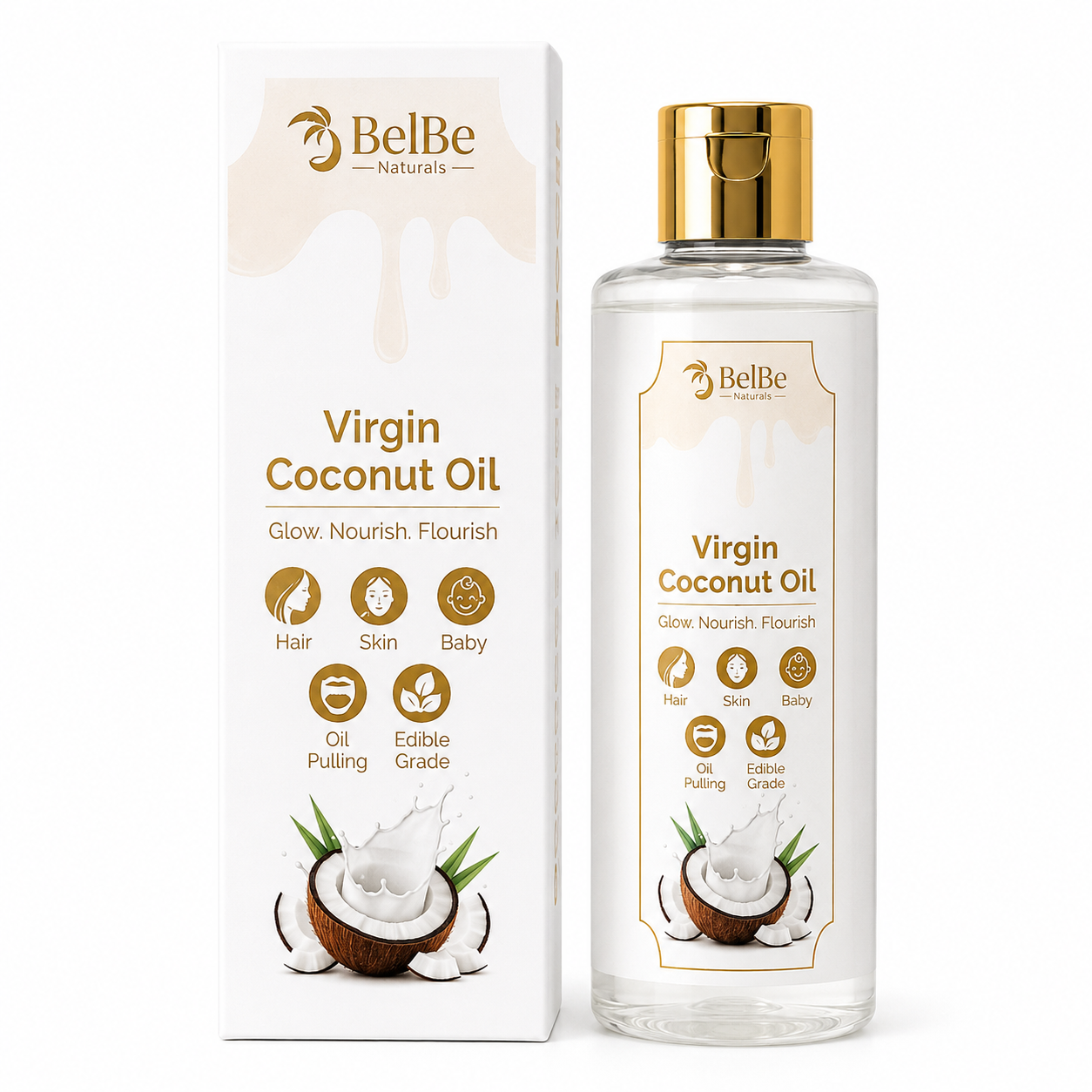
Virgin Coconut Oil for Face
Pure, cold-pressed coconut oil for simple, natural skin nourishment.
Is coconut oil right for your skin?
Answer three quick questions to see how BelBe VCO may fit into your skincare routine. Takes less than 30 seconds.
Whatever your result, we’d recommend patch testing on a small area first.
What can coconut oil actually do for your skin?
Coconut oil is an emollient and occlusive ingredient. Here’s what that actually means in practice — not a list of promises.
What it does
Coconut oil is an emollient, meaning it can help fill in rough or dry areas on the skin’s surface, making it feel smoother.
What you may notice
Skin may feel softer to the touch after use, particularly in areas that were dry.
How to use it
Apply a small amount to clean, slightly damp skin and press gently into the areas that feel dry.
What it does
As an occlusive, coconut oil forms a layer on the skin’s surface that can help slow water loss.
What you may notice
Skin may feel less tight or dry, especially in drier climates or seasons.
How to use it
Apply after cleansing, while skin is still slightly damp, to help lock in existing moisture.
What it does
The skin’s outer barrier relies on lipids to stay intact. An occlusive layer can help reduce moisture loss while it does its job.
What you may notice
Some people notice less dryness or flaking with consistent use.
How to use it
Use a small amount as the last step in your routine, so it seals in whatever you applied underneath.
What it does
Oils can help dissolve oil-based makeup and sunscreen, making them easier to wipe away.
What you may notice
Makeup, including some waterproof formulas, may come off more easily than with water-based cleansers alone.
How to use it
Massage a small amount onto dry skin to loosen makeup, wipe away with a soft cloth, then follow with your regular cleanser.
What it does
Coconut oil’s texture allows fingers to glide across the skin, which is useful for facial massage.
What you may notice
A smoother massage experience with less tugging on the skin.
How to use it
Apply a few drops and use gentle upward strokes, or your preferred massage technique.
How does it work with your skin type?
Coconut oil isn’t a universal fit. Here’s how it tends to work across different skin types.
Dry
Coconut oil is occlusive, which can help reduce moisture loss from the skin’s surface — a reasonable option for dry skin.
Watch for: if it feels heavier than you’d like, use less or apply to damp skin only.
Normal
Normal skin can often tolerate a light layer of coconut oil without issue.
Introduce it 2–3 times a week and see how your skin responds before using more often.
Combination
You may find it works better on drier areas of your face than on oilier ones, like the T-zone.
Apply only to the drier parts of your face rather than all over.
Oily
Coconut oil is a heavier, occlusive oil. Some people with oily skin find it sits too heavy or contributes to clogged pores.
A patch test on a small area is a sensible first step before wider use.
Sensitive
Even simple, natural ingredients can cause a reaction in some people — this isn’t unique to coconut oil.
Apply to your inner forearm, wait 24–48 hours, and check for irritation first.
Your simple VCO face routine
A practical starting point — adjust based on how your skin responds.
Cleanse
Start with clean, makeup-free skin.
Dampen
Leave your skin slightly damp rather than completely dry.
Use 2–3 drops
Start with a small amount — you can always add more.
Warm
Rub the oil gently between your fingertips to warm it slightly.
Press
Press the oil into your skin gently, instead of rubbing it in aggressively.
Use at night
Start a few times a week and adjust according to your skin’s response.
What’s actually inside?
Virgin coconut oil is naturally made up mostly of fatty acids. Here’s what a few of them are — not a claim about what each one does for your skin.
Lauric acid
The most abundant fatty acid in coconut oil, typically making up roughly half its composition.
Caprylic acid
A shorter-chain fatty acid naturally present in coconut oil in smaller amounts.
Capric acid
Another naturally occurring fatty acid found alongside lauric and caprylic acid in coconut oil.
Before you put coconut oil on your face
The point of this section is informed decision-making, not persuasion.
You may like it if you:
- Have dry skin
- Prefer simple skincare
- Like oil-based skincare
- Want minimal ingredients
- Prefer fragrance-free products
Think twice if you:
- Frequently experience clogged pores
- Have very oily skin
- Are acne-prone
- Have previously reacted to coconut-based products
Our recommendation
Patch test first, and stop using it if you notice irritation. This is general guidance, not medical advice.
More ways to use Virgin Coconut Oil
BelBe Virgin Coconut Oil is a single, versatile oil — here’s how the same bottle is commonly used beyond the face.
Face
Simple facial moisturising, as covered on this page.
Hair
Used as a hair oil for conditioning lengths and ends.
Body
A body moisturiser, and used for massage.
Lips
A simple, single-ingredient lip conditioner.
Makeup removal
Helps dissolve oil-based makeup before cleansing.
Baby massage
Used traditionally in Kerala for gentle infant massage.
Frequently asked questions
It can work well for some people, particularly those with dry skin, as an occlusive moisturiser. It’s not a fit for everyone — people prone to clogged pores may find it too heavy.
Virgin coconut oil is extracted without high heat or chemical refining, so it retains more of its natural compounds and aroma. Refined coconut oil is more processed and neutral in scent. Neither is inherently “better” for skin — it depends on your preference and skin type.
Coconut oil has a moderate-to-high comedogenic rating, meaning it can clog pores for some people, especially those who are already acne-prone. It tends to work better on dry, non-acne-prone skin.
You can, but it may feel heavy and could contribute to clogged pores for some people with oily skin. A patch test with a small amount is a sensible way to check how your skin responds.
There’s no fixed rule. Many people start with two to three times a week and adjust based on how their skin responds, rather than using it daily right away.
Yes, many people use it as an overnight step. Start with a small amount so it can absorb without leaving excess residue on your pillow.
Yes. BelBe Virgin Coconut Oil is cold-pressed from Kerala coconuts.
Yes, no fragrance is added. Any scent comes naturally from the coconut oil itself.
BelBe Virgin Coconut Oil is sourced from Kerala, India.
Store it in a cool, dry place, away from direct sunlight. Coconut oil naturally solidifies below about 24°C and turns liquid again above that — this doesn’t affect its quality.
Some people with sensitive skin tolerate it well; others don’t. Because it’s a natural ingredient rather than a formulated product, we’d recommend a patch test on a small area first.
Simple ingredients. Thoughtful skincare.
Discover BelBe Virgin Coconut Oil for Face.